


Copper and Beryllium Mould Alloys
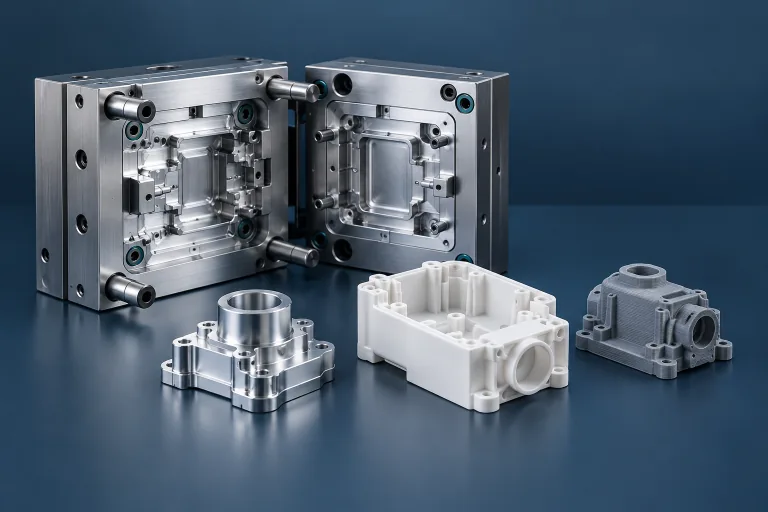

High-conductivity copper alloys may serve as cores or inserts at hot spots. Pure copper and mould alloys do not have the same strength. Heat must pass from the insert to the cooling circuit; follow the safety data sheet when machining beryllium-containing alloys.
Cu-Be: inserts needing both strength and heat transfer. Cu-Ni-Sn and Cu-Ni-Si-Cr: beryllium-free alloy families; equal hardness does not mean equal thermal performance.
Do not choose mould alloys by hardness alone. Consider conductivity, wear, corrosion, polishability, repair and heat transfer to cooling channels.
| Material / grade | Hardness / condition | Thermal conductivity ≈ W/(m·K) |
|---|---|---|
| MoldMAX HH — Cu-Be | 40 HRC | 130 |
| MoldMAX LH — Cu-Be | 30 HRC | 156 |
| MoldMAX XL — Cu-Ni-Sn | 30 HRC | 69 |
| MoldMAX V — Cu-Ni-Si-Cr | 28 HRC | 159 |
| PROtherm — Cu-Be | 20 HRC | 251 |
| Coolmould — Cu-Be | ≈40 HRC | — |
Values apply to the named commercial grade and test conditions, not to every material in the family. — means no verified value is provided here. Use the manufacturer's data sheet and material certificate.