

TASARIMDAN İMALATA
Machining Methods
Basic manufacturing operations are the processes required to produce a machine component. Depending on the part geometry and accuracy required, one or several machine tools may be used. CNC machines and suitable attachments can perform several operations on a simple workpiece in a single setup.
1. Turning
Turning removes material with a cutting tool or insert from a workpiece rotating in a chuck. It is performed on conventional lathes or CNC lathes, particularly for series production, and is used mainly for cylindrical parts and diameters. Operations include external and internal turning, facing, profile turning, grooving, threading, taper turning, parting, radiused and angled chamfering, and bore machining.
Lathes are fundamental manufacturing machines. Coated and indexable inserts have increased the material-removal capability of CNC turning and allow components to be machined efficiently with accurate dimensions and fine surface finishes.
2. Milling
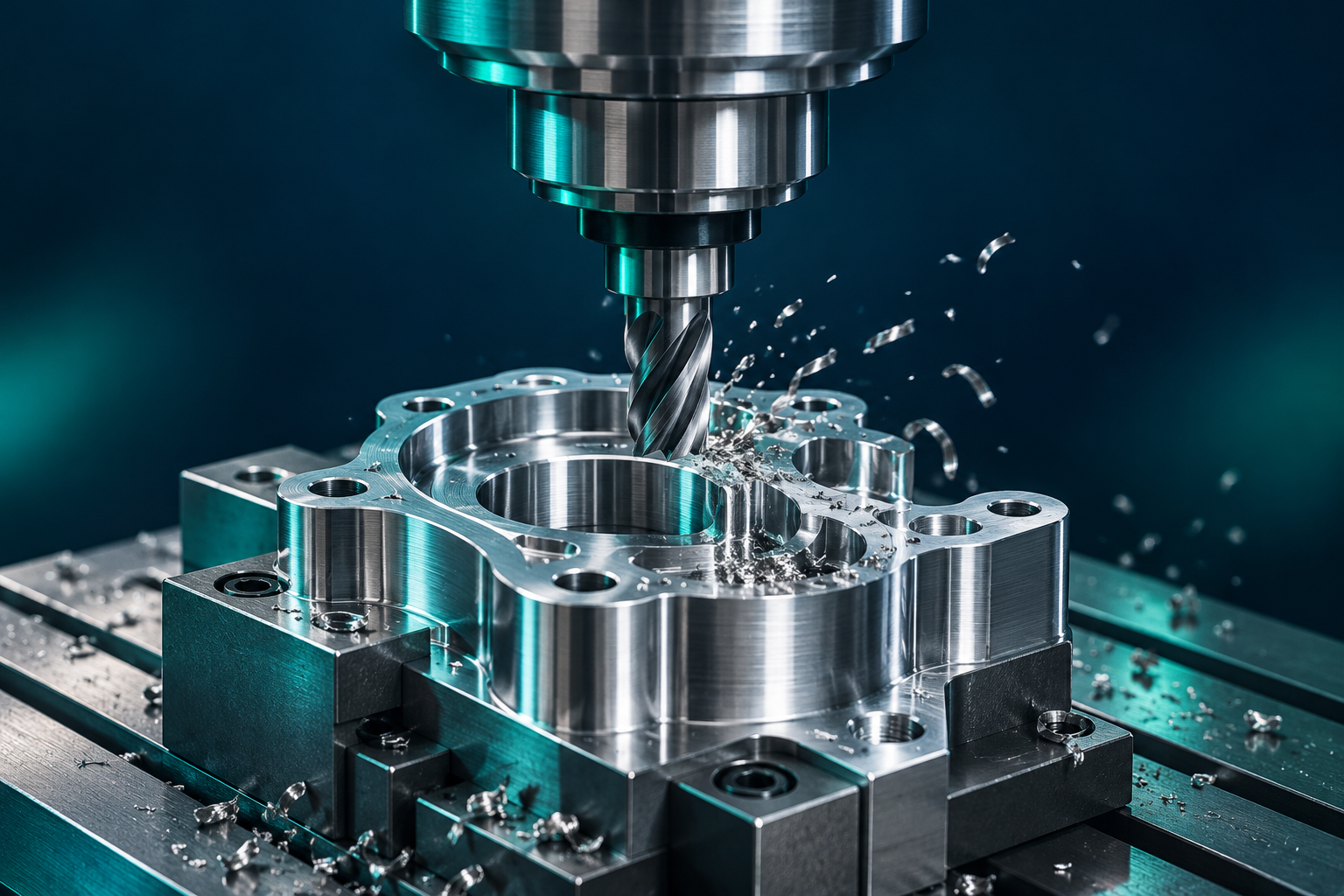
Milling uses cutting tools with one or more geometrically defined edges to produce flat or curved surfaces, slots, helical grooves, gears and threads. It also covers pocket and step machining, hole making and hole enlargement. Depending on the machine and operation, the tool, the workpiece or both move. Milling can be carried out on conventional machines or on CNC machines for precise work.
Typical processes include face milling, profile milling, slot milling, form milling and gear hobbing. Solid high-speed-steel (HSS) cutters and tools with coated indexable inserts are used. Milling can efficiently produce pockets, gears, large-pitch threads, helical and inclined surfaces, blind holes and other machined features. The available cutting capacity depends on the machine, tool, material and setup.
3. Drilling
Hole-making produces cylindrical through holes or blind holes of a specified depth. Drills rotate about their own axes; suitable milling cutters can also be used for hole-making operations. Work may be performed on a drilling machine, CNC lathe or CNC milling machine with the appropriate tooling. CNC milling is particularly useful for precisely positioned holes and blind holes with controlled depths.
Drilling is one of the most common manufacturing operations. HSS drills, coated drills and indexable-insert drills are used. The material-removal capabilities of modern cutting tools make them widely applicable on CNC turning, milling and drilling machines.
4. Reaming
Reaming improves a previously drilled hole by removing a small amount of material. Its purpose is to achieve accurate hole dimensions and a fine surface finish.
Cylindrical reaming is used for cylindrical holes, while taper reaming finishes tapered holes. The operation resembles drilling, but a reamer replaces the drill for the finishing cut. Straight-flute and helical-flute reamers are available.
5. Grinding
Grinding removes small amounts of material using abrasive wheels of different grain sizes to improve dimensional accuracy and surface finish. Abrasive grains held together by a bonding material make very small cuts in the workpiece.
Grinding is normally performed on grinding machines. Suitable additional equipment can also allow certain internal and external grinding operations on CNC lathes or milling machines, reducing additional setups where appropriate.
Grinding tools use natural or synthetic abrasive grains of different sizes held in a bond. The process can remove small amounts of material from very hard components that are difficult to machine by other methods.
Common methods include profile grinding, plunge grinding, cylindrical grinding and surface grinding. Other finishing and manufacturing processes include honing, lapping, broaching and polishing, selected according to the required geometry, precision and surface quality.